– Solution · Integrated Sports- & Financial Planning
Your squad is a balance-sheet asset.
So plan it that way, too.
Squad planning, wages, amortisation of player registrations, matchday and sponsorship all sit in a single model — and flow straight through to the P&L, balance sheet and cash flow. A contract extension shows up as a cash impact the very same day.
– How clubs still plan today
The sporting side plans. Finance recalculates.
Squad list in Excel
Contracts, options and clauses sit in a single file with no history. Extensions can't be simulated.
Player registrations outside the plan
Amortisation and book values are calculated separately and only brought together at year-end close.
Matchday detached from the bottom line
Ticketing, access control and hospitality produce figures that never make it into revenue planning.
Scenarios in heads, not in the plan
European qualification, relegation, an injury crisis: the numbers are only run once it has already happened.
Licensing under time pressure
Documentation for the league and governing body is pieced together from scratch every year instead of being generated from the model.
– With our approach
One number, two perspectives.
Contracts as a data model
Terms, options, bonuses and clauses, all versioned. Extension versus transfer is modelled as a scenario, not estimated.
Transfer logic built into the plan
Transfer fees, amortisation periods and residual book values flow automatically into the P&L, balance sheet and cash.
Matchday as a driver
Attendance, price tiers and access data drive revenue and staffing in the same model.
Scenarios at the click of a button
Qualification, league position, injuries and bonuses as versions, with the cash impact visible instantly.
Licensing documentation from the model
Reports for the league and governing body are an output, not a project.
– Scope
Four pillars. One model.
Squad & Staff
Wages, bonuses, contracts, market value trends, positional depth, academy progression.
Matchday & Revenue
Attendance, capacity, price tiers, turnstile flows, staffing, hospitality.
Commercial & Fans
Sponsorship, activations, memberships, merchandising, reach versus spend.
Planning & Scenarios
Top-down budgets with bottom-up drivers, versions, what-if analysis right through to the P&L, balance sheet and cash.
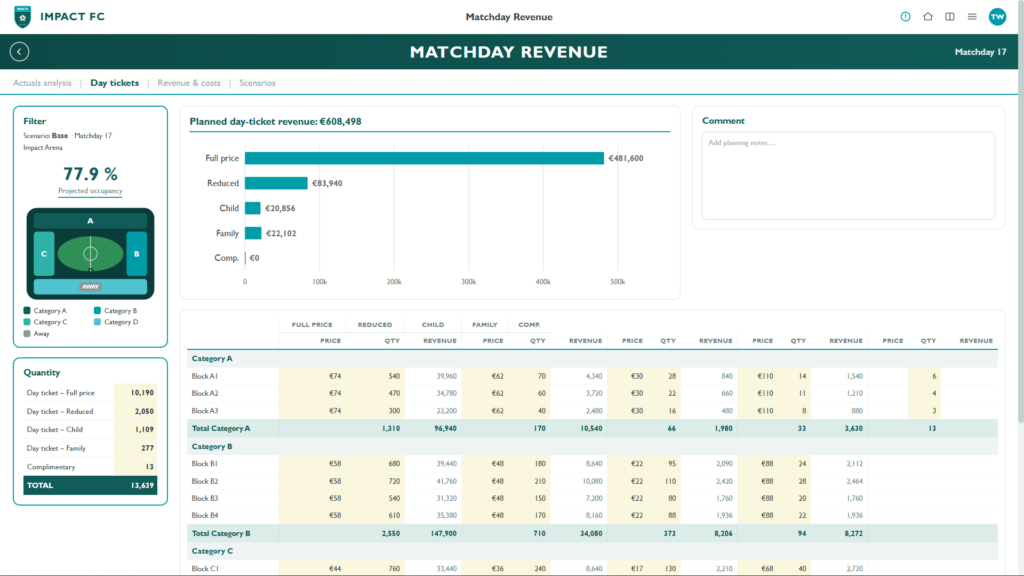
Block-level matchday planning: price and volume per ticket category, automatically rolled up into attendance and matchday revenue. Shown with sample data.
– In practice
The 90 minutes are unpredictable. The business behind them isn't.
At most clubs, ticketing planning comes down to a single line: last season's figure, a percentage on top, job done. That holds up as long as nothing changes. But as soon as a big fixture lands in the calendar, the away allocation is cut differently or a price review comes round, the number-crunching starts all over again, usually in a spreadsheet that only one person fully understands.
– Case studies
Sport and finance, steered as one.
Leading clubs in Austria and Switzerland are already showing the way. Sporting and financial data are brought together in Board to form a single shared foundation for decisions in day-to-day operations and in strategic planning.



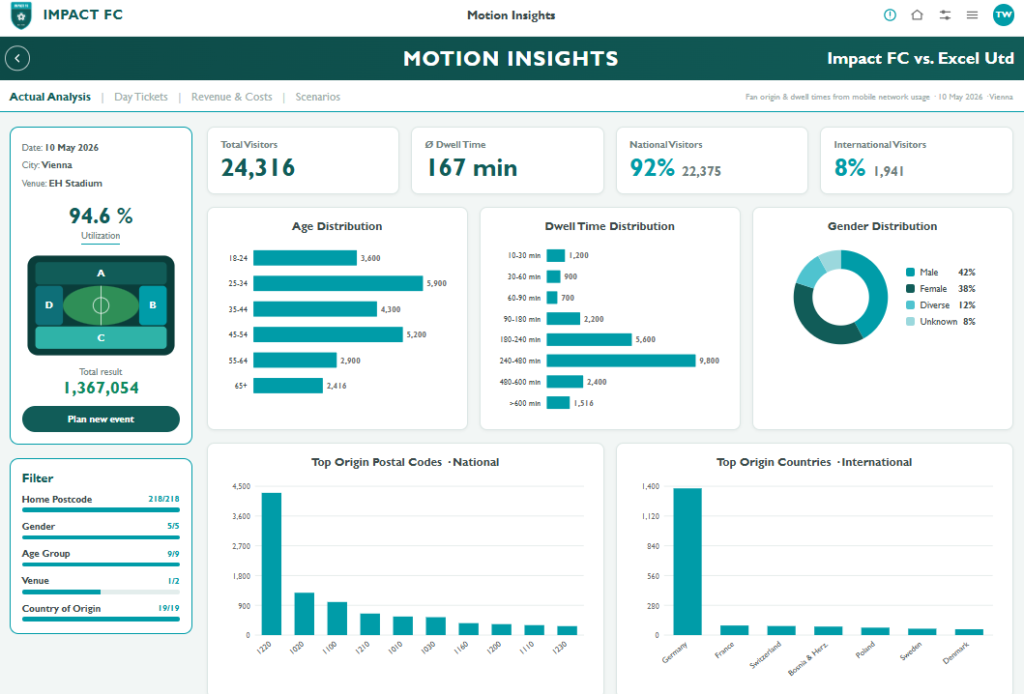
Matchday planning based on movement data enables even better planning of resources and future communication activities – not only in football, but for all kinds of events, visitor attractions, tourism destinations and retail.
– In practice
Know who’s coming – and plan the event around it
With the integration of Motion Insights from our partner Hutchison Drei Austria - one of the leading mobile network operators in Austria and present worldwide -, we connect anonymised movement data directly with your planning and reporting. At a glance, you can see how many visitors come to the stadium, where they travel from, how long they stay and how your audience is made up – both nationally and internationally.
The key difference: the data doesn’t sit in a separate tool. It flows into your existing planning environment alongside ticketing, revenue and costs. This lets you plan staffing, catering, security and arrivals based on actual demand, simulate scenarios for upcoming matchdays and target your communication at the regions and audiences you genuinely reach.
– Frequently asked questions
What clubs and governing bodies should know before getting started.
Do we need to replace our existing systems?
No. We read from your existing systems and, if required, can also write back to these source systems. Existing contracts and interfaces stay in place.
How do you handle sensitive planning data, such as wages?
Through roles and permissions within the model. For example, the sporting department sees positions and structures, while the board sees the figures. Both come from the same source.
Can this be used for licensing?
Yes. Reports for the league and governing body are generated as outputs from the model. The structure is tailored to the requirements of each individual league.
Is this solution also suitable for smaller clubs?
Yes. All you need to get started is one person responsible for financial control. For smaller organisations, finance as a service is often a better route than running a platform of their own.
– Initial Consultation
Let's run the numbers on your next transfer window.
Bring two players and one scenario. We'll show you how an extension, a transfer and an academy promotion each play out in your P&L and cash.